
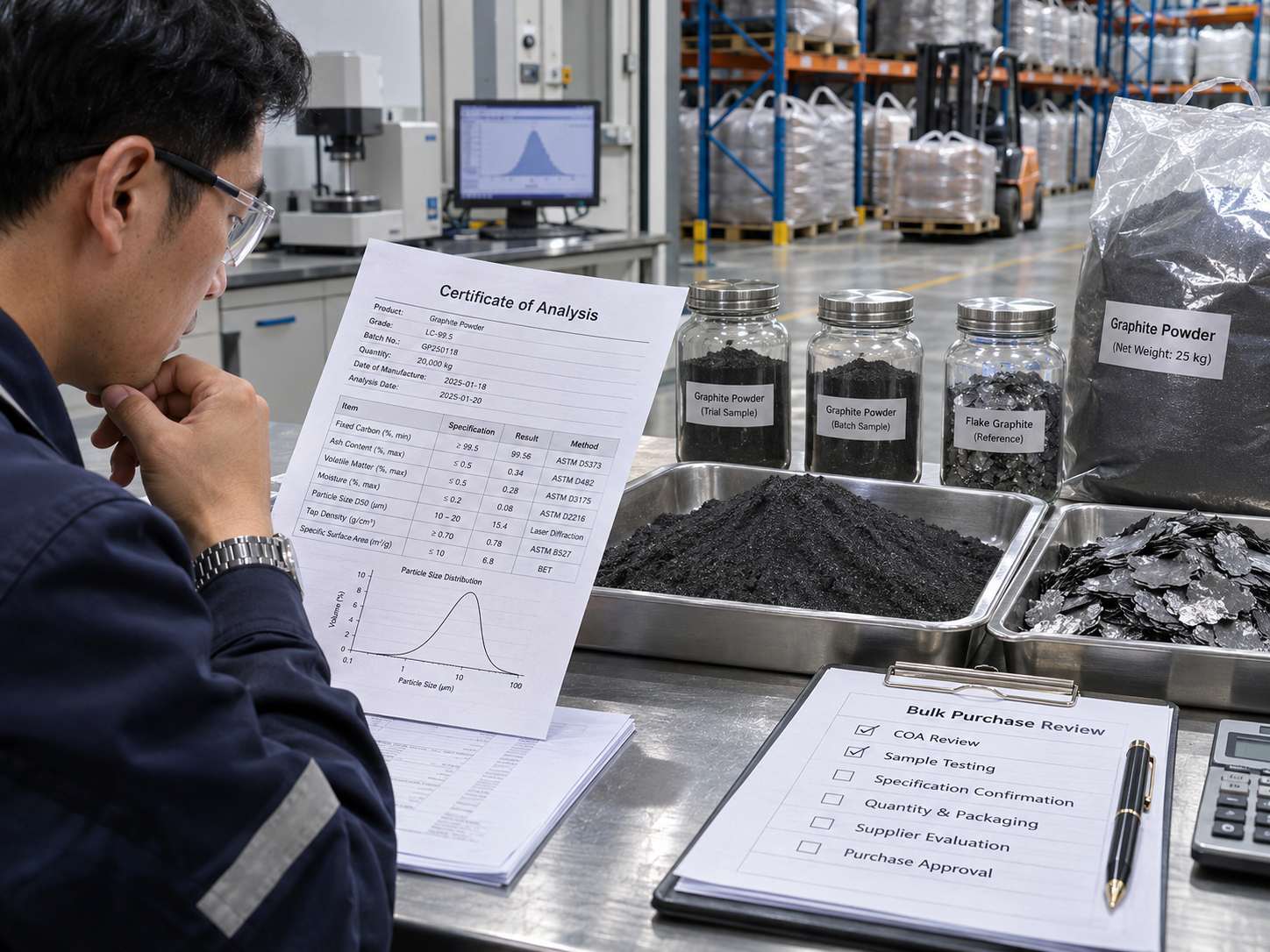
"Can we release this shipment?" The carbon result looks fine, but the graphite powder certificate of analysis has no lot number. I would send it back for clarification. That does not mean the powder has failed. It means the report cannot yet be connected to the order. Only after that connection is clear can the buyer compare the figures with the receiving terms.
Put the Quoted Grade Beside the Certificate
LG300-98 is one of the codes listed on Permanent Minerals’ high-carbon graphite page. The code gives us a useful example for following a purchase document through review. No real lot or test result is implied.
Follow the product code through the paperwork
The public table lists several codes within each carbon grade. If the quotation names LG300-98, that is the code I would carry into the order and check against the certificate. A report headed simply "high-carbon graphite" leaves room for confusion with another size option.
Where is the batch reference? Does the sample date make sense for the offered lot? Those are reasonable questions before the figures enter a receiving decision. If the report covers a sales sample, keep that identity too. Approval of that sample does not establish what a later shipment contains.
Read the column heading before the number
On the published table, fixed carbon is a minimum; moisture and volatile matter are maximums. They define the product specification. A lot certificate may put actual test results beside those boundaries.
The distinction is easy to miss when both documents are crowded with percentages. I would have trouble signing off a page that merely repeats the specification without saying what was measured. "Typical" creates the same question. Does this figure describe the sample in front of us, or the supplier’s usual product?
Decide What the Chemistry Results Actually Establish
With a named sample and grade, the certificate becomes easier to read. For our purchasing example, the next task is to compare composition results with the agreed limits, without asking them to predict the whole process.
Fixed carbon and the missing impurity question
For LG300-98, a satisfactory fixed-carbon result would clear one requirement. It would not identify each mineral remaining in the powder. Ash, where reported, is the residue obtained under the specified test; its total still leaves the composition of that residue open.
Suppose the buyer’s recipe limits a particular element. I would want that element analyzed, rather than infer its level from total ash. If the supplier has no such result, the issue remains open. Calling the graphite "clean" would not resolve it. Whether further analysis is needed depends on the buyer’s formulation.
Moisture and volatile matter in the buyer’s process
Moisture concerns the material weighed into production as well as its storage. A certificate reports the tested sample’s condition; it cannot describe what happens to an opened bag beside a wet work area.
Volatile matter is a separate test. Where the powder enters a heated mixture, the producer may need a limit for it. In our example, I would bring the production specification to this review instead of inventing a tighter number because a smaller percentage looks reassuring. The limit should have a reason.
Resolve the Screen-Residue Line Before Comparing Lots
The chemistry review has not answered the particle-size question. Permanent Minerals’ table also includes screen residue. Before accepting that line, our purchaser needs to know what screen and procedure the quoted requirement refers to.
Fill in the sieve details
Imagine the certificate contains a residue percentage without naming the sieve. This is a hypothetical paperwork omission, not a report about the supplier’s documents. I could read the percentage, but I could not arrange a matching receiving test from it.
The enquiry back to the supplier would ask for the opening, method, and whether the figure is retained or passing. A nominal mesh description does not supply all those details. The graphite application information covers different industrial uses; the same size description may need different scrutiny in a coating than in another blend.
Keep the production observation with the lot
If operators later say that the approved powder takes longer to mix, I would keep the note with its batch reference. What was weighed? Was the mixing sequence the same? Was the receiving sample prepared like the supplier’s sample?
Those questions leave room for a graphite difference and a production difference to be investigated. The observation is valuable even before its cause is known. An unlabeled handful of powder collected days later would be much harder to use for that work.
Agree How the Buyer Will Handle an Unclear Result
By now our hypothetical order has a named grade and a set of properties to check. The remaining work is to decide what accompanies the delivery and what happens if receiving finds a discrepancy.
The bulk graphite procurement guide brings packaging and shipment details into this discussion. I would add the required certificate fields to the same order record. Otherwise the buyer may discover at arrival that everyone expected a different document.
A receiving plan can name the sample procedure, any retained samples, and who reviews an exception. If a result falls outside the purchase limit, hold the affected material while the two parties investigate under their agreement. Comparing identified samples with the same method is a sensible starting point. Repeating an unexplained test until it passes is not.

Taking the Grade Enquiry to Permanent Minerals
PERMANENT MINERALS describes an operation covering mining, crushing, flotation, dewatering, drying, and screening. For the example here, I would ask which current grade corresponds to the proposed order and what information is available for qualification.
There is no need to have every test settled before making contact. Start with the application and the carbon and size requirements already known. Ask for current specifications and discuss sample availability. Quantity and destination can support the quotation; unresolved acceptance details need agreement before supply is approved.
Conclusion
The review starts with a quoted code and ends with a receiving decision about identified material. Keep the grade table, lot certificate, and purchase limits together. Any missing method or reference then becomes a specific question to settle, rather than a reason to guess at the quality of an entire shipment.
FAQs
Can a product specification replace a CoA?
It cannot establish a lot’s measured results. A product specification helps define the order; the purchaser still needs the agreed evidence for that delivery.
Must the buyer repeat every supplier test?
That is a purchasing and qualification decision. Agree which checks matter before dispatch, including how the receiving sample will be taken.
Does a passing CoA approve a new formulation?
It establishes only the requirements covered by the report. A different binder or production route may need further assessment in the buyer’s process.