The choice of medium carbon and high carbon graphite is a well-defined process selection approach.It is not just the issue of picking the highest one out of the quote. The buyers will have some special needs concerning the properties of conductivity, lubrication, corrosion-resistance, etc. The choice of the proper grade depends on the application of the powder significantly. It also depends on important impurity limits. Furthermore, the particle size must fit the processing equipment. Permanent Minerals offers medium carbon graphite within the 80–93% fixed-carbon range. The company provides high carbon graphite in the 94–99% range. These specific bands offer a helpful starting point to compare both options.
What Is the Difference Between Medium Carbon and High Carbon Graphite?
The difference between the two is mainly with regards to the content of fixed carbon. But this becomes only the first step in filtering out the product. Consumers should further evaluate factors such as the amount of volatile material, moisture, and the sieve analysis. The particle size classification should also be looked into. A specific grade might seem superior on a data sheet. Yet, it could increase expenses without actually helping the manufacturing process. This happens when the end use simply does not require that extra carbon.
How Is Medium Carbon Graphite Defined?
Based on the Medium Carbon Graphite product page, this material features 80–93% fixed carbon. The site highlights solid electrical and thermal conductivity. It also notes a high melting point, lubricity, and plasticity. Chemical stability and oxidation resistance are key traits too. Listed applications cover metallurgy, casting, and lubrication tasks. Sealing products, refractory additives, and flexible graphite materials use it as well. Some battery-related absorbent goods rely on this grade. Additionally, the webpage displays 92% and 93% grades. These specific types have a maximum moisture value of 0.5%. They also feature a volatile-matter limit of 1.5% within the published index.
How Is High Carbon Graphite Defined?
The High Carbon Graphite product page classifies this product as having 94–99% fixed carbon. The text points out its role as a conductive or refractory substance. It works well as a wear-resistant lubricant. Manufacturers utilize it for electrical, mechanical, and pencil goods. Casting and metallurgical items benefit from it too. The provided high-carbon index contains 94%, 95%, 96%, 97%, and 98% brands. All these options carry a maximum moisture value of 0.5%. Interestingly, the 98% entries display a tighter volatile-matter limit compared to the 94–97% choices. Therefore, purchasers ought to ask for the precise grade table. They should not depend solely on the broad category name.
Which Grade Should Buyers Choose for Conductivity and Heat?
The need for good conductivity and heat resistance often makes consumers opt for graphite that has a lot of carbon in it. However, the need depends entirely on the composition of the material. The operational condition is a big factor too. It is important to begin by setting an objective. Only after doing this can one assess whether the carbon provides value.
When Can High Carbon Graphite Be the Better Fit?
High-carbon graphite can be considered a good choice in cases where the manufacturing process is very sensitive to mineral impurities. This type of material is appropriate in case the required feature is the high conductivity of the carbon part. This material may also be applied for projects where the specific features associated with a higher carbon fixed level are needed. The company website mentions electrical products and coating products. Refractory materials, metallurgical moulds, and wear resistant lubricants are examples of its applications. These are short descriptions that can be used in the preliminary discussions. But they never substitute the practical test of the material.
When Can Medium Carbon Graphite Be Sufficient?
Medium carbon graphite is frequently adequate. This happens when a factory needs standard lubricity or chemical stability. Basic conductivity or heat resistance might be enough without paying for the maximum carbon bracket. The product site lists metallurgy and casting. Flexible graphite, lubricant additives, and refractory additives appear there. Sealing-related tasks are also prominent. For any budget-conscious recipe, a medium carbon grade deserves proper testing. Engineers should run it next to a high carbon benchmark. They just need to ensure that carbon, ash, moisture, and particle size are checked fairly. Final-product results must be evaluated using the exact same methods.
How Do Particle Size and Screen Residue Affect Grade Selection?
Fixed carbon alone never dictates flow rates or dispersion quality. It does not control coating coverage or packing habits by itself. Instead, particle size heavily impacts how the raw powder drops into a mixer. It affects how the material fills a mold or spreads across a coated surface. It also changes how the substance travels through an automated feeder. Therefore, a purchaser must clearly state the required mesh. They should provide the exact size distribution alongside the carbon range. Merely asking for general "graphite powder" is too vague.
Why Should Mesh Be Matched to the Process?
A coarse grade can greatly assist a refractory or metallurgical mix. Such blends often require a very specific packing structure. Conversely, a finer grade usually disperses much easier inside a liquid coating. It blends better into a lubricant or a dense sealing compound. The most practical choice relies entirely on the factory equipment and the target end item. Clients should ask their supplier to clarify the screen-residue basis. They must know the exact test method used. Afterward, they can compare a fresh representative sample against their currently approved grade.
What Do the Published Product Tables Tell Buyers?
The official product tables display several distinct brands. These include 500, 300, 180, 150, and 100 mesh sizes. They also feature negative mesh designations for high carbon graphite. Meanwhile, the medium carbon page outlines very similar mesh families. It shows 180, 150, and 100 mesh options. Negative mesh grades appear there as well. This setup proves that the carbon range and the particle-size option remain entirely separate selection factors. A smart buyer will request both details on the formal quotation. They should also demand them on the final certificate of analysis.
What Should Be Included in a Medium or High Carbon Graphite Trial?
Running a brief, carefully controlled trial stops expensive mistakes. Relying on just one specification number is risky. Facilities must use identical process settings for both grades. Then, operators should document the exact results that matter most to daily production.
Compare the Material Before It Enters Production
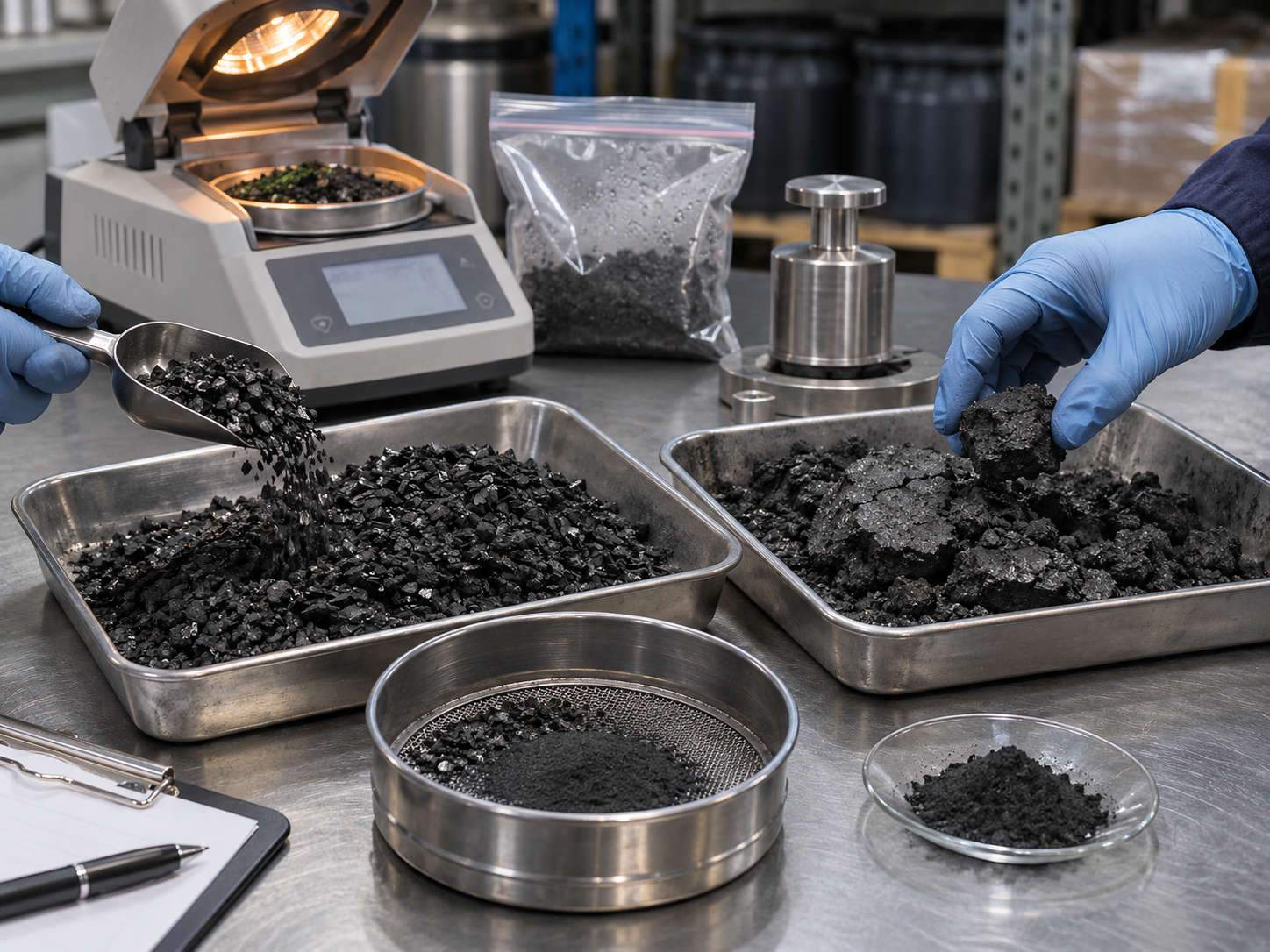
First, request the current technical specification. Ask for a truly representative sample and a lot-specific certificate of analysis. Make sure to record the fixed carbon, volatile matter, and moisture. Log the particle size, screen residue, and ash levels. Note any other agreed impurities, packaging types, and batch identification numbers. Always keep the medium and high carbon samples completely separate. If the cargo ships by sea, keep a physical arrival sample. Retain the pre-dispatch sample too. This practice ensures any future handling complaints are backed by solid evidence.
Measure the Finished Product, Not Only the Powder
In examining the refractory material, the mixing and molding operations should be observed. Observations of the drying operation and high-temperature properties are required. With respect to lubricants, dispersing qualities, coefficient of friction, and wear should be determined. The stability of storage is important as well. In the case of the sealing material or the flexible graphite mixture, compressibility is essential to test. Recovery, leakage prevention capability, and processability are the factors to consider. Only when all requirements of the final product are satisfied will a particular grade be acceptable. Higher fixed-carbon content does not necessarily mean superiority.
How Can Permanent Minerals Support Grade Selection?
Permanent Minerals Co., Ltd. details a fully integrated operation. This setup covers mining, crushing, and flotation purification. It includes dewatering, drying, and precision screening steps. The official About Us page confirms the firm can deliver powders ranging from 80 mesh to -325 mesh. It lists various carbon-content and particle-size choices for natural flake graphite. Purchasers can leverage this production data to build a highly focused inquiry. They should state their intended application and target carbon range. They must include the desired particle size, moisture limit, and order quantity. Packaging preferences and the final destination are vital too. After sharing these facts, buyers can ask which available grade best fits their trial plan. Furthermore, the graphite application page highlights common graphite uses. It covers basic industries, energy sectors, general manufacturing, and advanced technology fields.
Conclusion
Medium carbon and high carbon graphite address entirely different purchasing scenarios. Medium carbon graphite spans an 80–93% fixed-carbon range. It often fits applications where basic conductivity or lubricity matters. Chemical stability and a good cost balance are also key factors here. Conversely, high carbon graphite spans the 94–99% bracket. Factories might prefer this option when a richer carbon phase is necessary. Tighter impurity control can also justify this choice. In both situations, the final decision must combine multiple factors. Buyers must weigh fixed carbon, particle size, and moisture. They must look at volatile matter, screen residue, and actual trial results. Proper shipment documentation is equally important. Ultimately, a crystal-clear specification provides the buyer with a much stronger foundation. It makes comparing different quotations easier and helps approve a truly repeatable grade.
FAQs
Is high carbon graphite always better than medium carbon graphite?
No, it is not. High carbon graphite is frequently unnecessary for certain processes. A facility might easily hit all finished-product goals using a standard medium carbon grade. Companies should always compare both grades under identical application conditions. They must factor the total cost, particle size, and strict impurity limits into their final choice.
What fixed-carbon range is medium carbon graphite?
Permanent Minerals classifies medium carbon graphite as having 80–93% fixed carbon. However, clients must still verify the exact grade. They should check the official product specification and the unique lot certificate.
What information should a buyer send when requesting a graphite quote?
Buyers must share their specific application and the target fixed-carbon range. They should provide the exact particle size or mesh requirement. Moisture limits and volatile-matter constraints are essential. Order quantity, packaging type, and the delivery destination must be included. Finally, list any required documents and explain the planned trial or approval method. Supplying these details gives the vendor enough solid information. It allows them to suggest a proper grade for a fair and accurate evaluation.